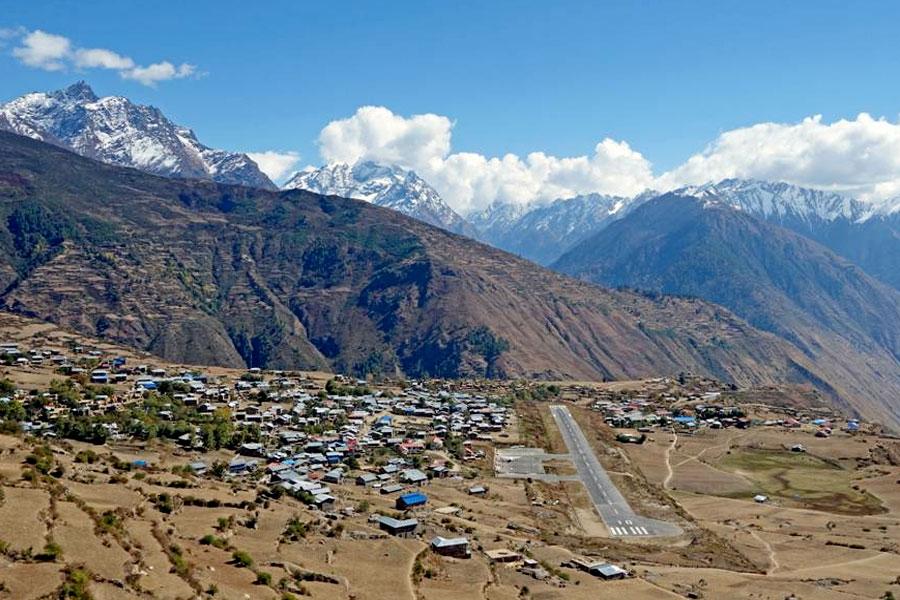
From here, the trail ascends through meadows and across streams to Thado Dhunga at 4160m. We then climb to Sipsip, near the foot of the Nara Lagna pass, at 4330m. Despite the remoteness of this location, there is a considerable amount of traffic. We will meet traders, pilgrims and pack animals-goats, sheep and yaks. Local yaks and crossbreeds carrying timber to Tibet are frequently seen. The upper Humla people, especially the people from Muchu VDC have no other form of livelihood than the export of timber to Tibet. The export of raw materials from Humla, either timber to Tibet or herbs to India, does not really benefit the locals economically, and has been resorted to since the dying out of the trans Himalayan caravan trade. But now, WFO's Food for Work programme is providing at least a temporary alternative to the local people while they contribute to the building of the road. From Sipsip, the trail makes a steep, continuous ascent along the side of the ridge above Shipship to a huge rock cairn atop the Nara Lagna pass at 4580 m. A short distance below the pass, We round a ridge for a view of the Tibetan Plateau, the Humla Karnali, and the green barley fields of Sher far below. From the Nara Lagna pass, you follow the newly built trail down to Hilsa at 3730 m. After crossing the Karnali suspension bridge at Hilsa, We ascend about 20 minutes and reach at 3860m, the first border village of Tibet, called Sher on the Chinese side. This border is perhaps one of the most informal border crossings in the world and serves as a trading mart with Nepal. At Sher, Our vehicle will be waiting for us to pick up our entire tour to Tibet, Mt. Kailash.
Meal
Breakfast, Lunch & Dinner
Transportation
Jeep/Van/Bus
Accommodation
3/4 Star Hotel

 English
 简体中文
简体中文 Nederlands
 Français
 Deutsch
 Italiano
 Português
 Русский
 Español
 日本語
日本語